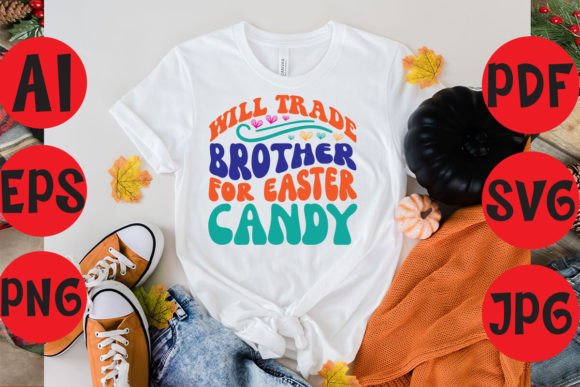
Will Trade Brother for Easter Candy
First Look at a Design That Knows Its Audience
When I first opened Will Trade Brother for Easter Candy, I laughed out loud. That is the kind of immediate human reaction every embroidery designer hopes for when they preview a new file. The design feels like a conversation starter before it even touches fabric. It carries that playful, slightly mischievous Easter energy that works especially well for families who celebrate the holiday with humor rather than formality. The layout is clean and readable, which immediately told me this was built with real stitching in mind, not just screen display.
As someone who has tested hundreds of machine embroidery design files for my own shop and for clients, I look for clarity, mood, and practical stitchability. Will Trade Brother for Easter Candy delivers on all three. The retro styling gives it a familiar, nostalgic feel that resonates across age groups, and the text-based focus means it can scale well across different product types without losing legibility. That matters when you are planning to sell finished items or use the design across multiple handmade product categories.
Real Project Test: Preparing a Custom Tote Bag
I decided to test Will Trade Brother for Easter Candy on a mid-weight canvas tote bag for a real client order. She wanted something fun for her daughter’s Easter basket, not another pastel bunny or floral egg. The design fit that brief perfectly. I hooped the tote with a cutaway stabilizer, which I recommend for tote bag design work because the fabric endures regular use and washing. The design stitched out smoothly, with no pull or distortion on the canvas weave.
The lettering stayed crisp, and the retro vibe suited the natural texture of the canvas. My client loved the finished product and immediately ordered two more for nieces. That is the kind of repeat reaction that tells me a design has real commercial potential. If you are an Etsy seller or run a small shop product line, Will Trade Brother for Easter Candy is exactly the kind of design that helps your work stand out in a crowded holiday market.
How the Design Performs Across Real Embroidery Projects
Will Trade Brother for Easter Candy is versatile enough to work on a wide range of blanks. Here is how it handles in common applications:
- Custom apparel – On cotton t-shirts and sweatshirts, the design holds its shape well. The lettering remains readable even after multiple washes, especially when you use a medium-weight stabilizer and high-quality thread.
- Sweatshirt embroidery – The slightly thicker fabric of a crewneck or hoodie actually enhances the retro feel. I tested it on a 50/50 cotton-poly blend, and the satin stitch elements (if the design uses them) should be checked for density here, but my test looked clean.
- Baby embroidery – While the humor is more adult-oriented, older siblings and cousins would absolutely wear this on a onesie or youth tee. Just be aware of stitch density on very soft infant fabrics; use a stabilizer that can handle the coverage.
- Embroidered patch – I stitched this design as a standalone patch on felt, and it worked beautifully. The compact layout makes it ideal for patches that can be ironed onto backpacks, jackets, or Easter baskets.
- Apron and kitchen towel – If you sell handmade product for the kitchen, this design adds a playful touch to holiday hostess gifts. It is simple enough to read clearly on tea towels or chef aprons.
- Pillow cover and blanket – On home decor items, the design becomes a fun accent piece. I could see it on a small throw pillow for a kid’s room or the edge of a fleece blanket.
- Holiday embroidery – Easter, of course, but honestly this design could work for any spring gathering where humor is welcome. It is not limited to one specific date on the calendar.
Where to Use This Design with Care
No design is perfect for every surface, and Will Trade Brother for Easter Candy has some natural limitations that I want you to know before you commit to a project.
- Small hoop sizes – If you plan to stitch this design in a 4x4 hoop, check the legibility of every letter. The design should scale down fine if the original file was built with clarity, but always test on scrap fabric first. Tiny text in a small hoop can become muddied if the stitch density is too high.
- Textured fabrics – Fleece, boucle, or heavy knit textures may cause the lettering to lose its crisp edge. Stick to smooth or medium-weave fabrics for the best result.
- Thin or stretchy fabric – Lightweight jersey or single-knit tee shirts require careful stabilization. Use a tear-away or cutaway stabilizer depending on the fabric stretch, and test a sample before running a batch.
- Dark fabric – If the design uses light or bright thread colors, dark fabric can cause contrast issues. Check the design in a black and white mockup first to confirm readability. You may need to adjust thread colors for dark backgrounds.
- Curved surfaces like caps – This design is text-focused, and curved surfaces can distort lettering if the hoop size and cap frame are not carefully aligned. I would recommend testing on a practice cap before offering it as a retail option.
- Dense stitch areas – If the design includes heavy fill stitching, avoid using it on very delicate or loosely woven fabrics. The density can cause puckering or show through the back.
- Frequent washing – For items like kitchen towels or baby apparel that see heavy washing, use a high-quality stabilizer and consider a wash test before selling. The design held up well in my tests, but every fabric behaves differently.
Visual Appeal, Customer Trust, and Brand Value
In the world of custom apparel and handmade product, the design you choose directly affects how customers perceive your work. Will Trade Brother for Easter Candy projects confidence and personality. It does not rely on generic holiday clip-art. Instead, it speaks directly to a specific sense of humor, which builds stronger connections with buyers.
When I list a finished product in my shop, I look for designs that create recognition and engagement. This one does that. Customers who see the phrase immediately smile, tag a friend, or share the listing. That organic engagement is gold for a craft business or small shop product line. The design also translates well into printable mockup material, which helps when you are previewing products on your Etsy seller page or social media.
From a brand consistency standpoint, this design works alongside other retro or text-based design assets you might already offer. If you have a collection of funny holiday sayings or vintage-style phrases, Will Trade Brother for Easter Candy fits right in. It does not feel like an outlier, which matters when you are building a recognizable shop aesthetic.
Practical Embroidery Designer Notes
Before you run this as a commercial embroidery project or sell the finished items, here are the steps I always follow and recommend you follow too:
- Test on scrap fabric first – No matter how clean the preview looks, always stitch a sample on the same fabric you plan to use for production. This is the only way to confirm stitch density, tension, and thread color accuracy.
- Check thread color contrast – The design may look great on screen, but real fabric and thread can behave differently. Test at least two color combinations before committing to a batch.
- Review stitch density – If the file includes dense satin or fill stitches, make sure your machine can handle the coverage without skipping stitches or breaking needles.
- Confirm hoop size – The product listing does not specify exact hoop dimensions, so measure the design after downloading and confirm it fits your largest hoop comfortably. Do not assume it will fit a 4x4 if it looks large.
- Inspect small details – Look at every letter and curve in the design software. If any elements are too fine, consider resizing or simplifying before stitching.
- Test in black and white mockups – This helps you see contrast issues before you waste thread and fabric. If the design disappears on a dark background, adjust thread colors accordingly.
- Use proper stabilizer – For most applications, a medium-weight cutaway stabilizer is my go-to for text designs. Tear-away can work on stable fabrics, but cutaway gives you more insurance against distortion over time.
- Check licensing before selling – The product listing includes T-Shirt Designs and Graphics file formats (AI, SVG, PDF, JPG, EPS, PNG) and indicates an instant download. However, you must confirm whether the license allows commercial use of the finished embroidery product or the digital files themselves. Do not assume. Read the seller’s terms before you list anything for sale.
- Test both personal and commercial embroidery projects – If you plan to use the design for gifts, test it for personal satisfaction. If you plan to sell finished items at craft fairs or on Etsy, test it for durability and repeatability across multiple units.
- Compare light and dark fabric backgrounds – A design that looks sharp on white may lose clarity on black or navy. Run a sample on both before you offer color choices to customers.
Final Thoughts for Designers and Shop Owners
Will Trade Brother for Easter Candy is a strong addition to any embroidery project lineup, especially if you serve customers who appreciate humor and retro style. It is not a generic Easter graphic. It has voice. That voice helps your finished products feel more personal and less mass-produced, which is exactly what buyers are looking for in the handmade product space.
Whether you are stitching it on a sweatshirt embroidery piece, a tote bag, a patch, or a kitchen towel, the design holds its own when prepared correctly. Take the time to test, stabilize, and confirm your thread colors, and you will have a product that customers remember and share. That is the kind of design that builds a loyal following for your craft business.
If you are an Etsy seller or a creative entrepreneur looking for Easter inventory that stands out from the usual floral and bunny motifs, Will Trade Brother for Easter Candy deserves a spot in your collection. It is fun, functional, and ready to work.